Knowledge Hub
Decree 112 explained: Vietnam's new rules for selling carbon credits abroad

Vietnam's Decree 112/2026 sets out which carbon credits can leave the country, how many, and who approves them. Here is what it says, and what it means for developers and buyers.
Until this year, anyone buying carbon credits from Vietnam faced an open question: could those credits legally leave the country, and on what terms? Decree 112/2026/ND-CP answers it. Issued on 1 April 2026 and in force since 19 May 2026, the decree sets out how emission reductions and carbon credits generated in Vietnam can be transferred internationally, how much of them can go, and who decides.
For project developers it defines what share of their credits they can sell abroad. For buyers it defines which Vietnamese credits can count toward compliance obligations. Here is what it says.
Decree 112 in eight facts
- Issued
- 1 April 2026
- In force
- 19 May 2026
- Authority
- Ministry of Agriculture and Environment
- Covers
- Article 6.2, Article 6.4, independent standards
- Max. abroad (priority)
- 90%
- Max. abroad (other)
- 50%
- Compliance route
- Letter of Authorisation
- LoAs issued so far
- None (Oct 2026)
Scope and authority
Decree 112 covers international transfers under both routes of Article 6 of the Paris Agreement:
- bilateral cooperation between countries (Article 6.2), and
- the UN’s Paris Agreement Crediting Mechanism (Article 6.4).
It also applies to credits issued under independent standards such as Verra and Gold Standard, provided they meet the decree’s minimum criteria. Existing projects under those standards remain eligible, but any international transfer now falls under Vietnamese rules.
Authority sits with the Ministry of Agriculture and Environment (MAE), Vietnam’s designated national authority for Article 6. The ministry was formed in 2025 from the merger of the former Ministry of Natural Resources and Environment and the Ministry of Agriculture and Rural Development.
How much can leave the country
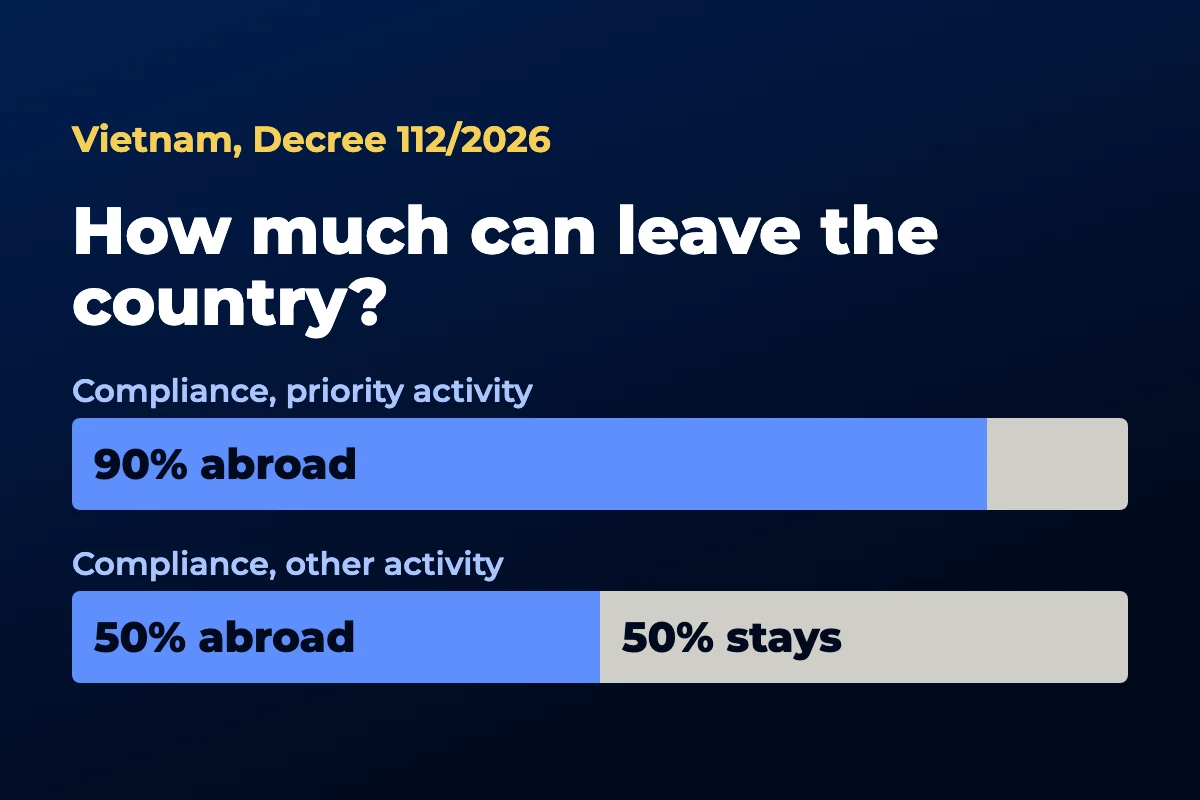
The decree’s central feature is a cap on the share of a project’s credits that may be transferred abroad. The remainder stays in Vietnam and counts toward the country’s own climate target (NDC).
| Transfer type | Maximum transferable |
|---|---|
| Priority activities listed in Annex I, with corresponding adjustment | 90% |
| All other activities, with corresponding adjustment | 50% |
| Transfers without corresponding adjustment | 90% |
The priority list favours large-scale, high-technology and high-impact activities, with renewable energy and emerging technologies such as green hydrogen reported among them. Developers should check Annex I against their own activity before building a business case. The gap between 50% and 90% can determine whether a project is viable for export.
How many of your carbon credits can leave Vietnam?
Up to 90% can leave Vietnam
Can be transferred abroad
Up to 9,000
Authorised with a corresponding adjustment. Usable toward another country's NDC, CORSIA, or eligible compliance schemes.
Stays in Vietnam
At least 1,000
Counts toward Vietnam's own NDC and stays in Vietnam's national registry.
Approval: A Letter of Authorisation from Vietnam's Ministry of Agriculture and Environment, issued after the credits are issued. Vietnam removes the transferred tonnes from its national accounts.
Two pathways
The decree separates transfers by whether Vietnam applies a corresponding adjustment, meaning it removes the transferred reductions from its own national accounts.
With a corresponding adjustment. This is the compliance-grade route, required when credits will be used toward another country’s NDC, under CORSIA, or under schemes such as Singapore’s carbon tax. The transfer needs MAE’s prior approval in the form of a Letter of Authorisation (LoA). The decree places this step after credits are issued, so authorisation is granted on verified results rather than projections.
Without a corresponding adjustment. This route suits voluntary corporate claims. It requires only notification to the authorities, not prior approval.
Every international transfer, on either route, must be recorded in the national registry operated by MAE, where each unit carries a unique identifier. Article 6.4 activities register through the National Public Service Portal.
From project to international transfer
- Register the project
- Project documentation approved
- Monitor and verify reductions
- Credits issued
- Apply to transfer abroadWith corresponding adjustmentCompliance use (NDCs, CORSIA, carbon taxes). MAE issues a Letter of Authorisation after issuance. Up to 90% or 50%.Without corresponding adjustmentVoluntary claims only. Notification to the authorities. Up to 90%.
- Transfer recorded in the national registry
Where Vietnam stands
Vietnam's Article 6 partners
- Japan
- Joint Crediting Mechanism, since 2013
- Singapore
- Implementation agreement, Sep 2025
- Republic of Korea
- Article 6.2 agreement
The legal framework is now among the most detailed in Southeast Asia. Implementation is still at an early stage:
- No LoA has been issued yet, and no corresponding adjustment has been applied. Vietnam has also yet to submit its Article 6 Initial Report to the UNFCCC.
- Bilateral channels are in place: Japan’s Joint Crediting Mechanism (since 2013), an implementation agreement with Singapore (September 2025), and an Article 6.2 agreement with the Republic of Korea.
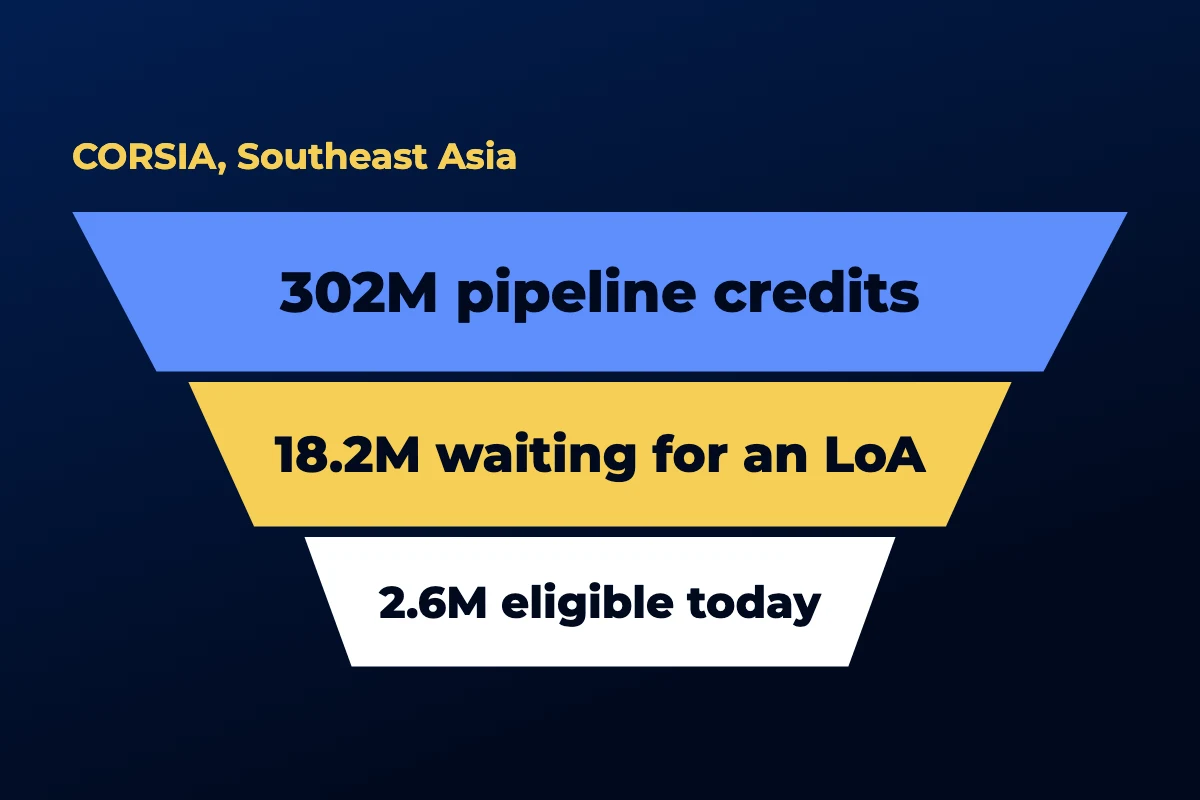
- The stakes are significant. Abatable estimates that more than 60% of ASEAN’s potential CORSIA opportunity from already-qualifying projects lies in Vietnam, provided those credits are authorised.
The first LoAs will therefore be a key signal for the market. They will show how quickly MAE processes applications and how it applies the transfer caps in practice.
What it means for developers and buyers
For project developers, Decree 112 turns authorisation into a design question rather than an afterthought:
- Confirm early whether your activity falls under the 90% or 50% cap.
- Plan what to do with the share that must remain in Vietnam. It can still serve domestic or voluntary demand.
- Build monitoring and registry records to the standard MAE will review. Authorisation is assessed on issued, verified credits.
For buyers, the decree clarifies what to ask:
- Are the credits intended for transfer with a corresponding adjustment? Only these qualify for compliance use.
- Until the first LoAs are issued, treat compliance-grade Vietnamese credits as forward supply, and make contracts conditional on authorisation.
Decree 112 does not guarantee authorisation, but it makes the path to it clear. For a country with Vietnam’s project pipeline, that clarity is the first step toward becoming a major supplier to the region’s compliance markets.
Sources
- Decree 112/2026/ND-CP (English translation), LuatVietnam
- VILAF, Defining carbon value: Vietnam introduces rules for international transfers under Decree 112
- Duane Morris (Oliver Massmann), Vietnam unlocks its carbon market: Decree 112/2026
- Abatable (2026), Unlocking the billion-dollar CORSIA potential in ASEAN, Table A32 and “Recommendations for governments”
This article is for general information only and is not legal or investment advice. Figures are as of the dates stated and may change.