Knowledge Hub
CORSIA's missing credits: 18 million Southeast Asian credits are waiting for one signature

Airlines need about 200 million CORSIA credits. Southeast Asia has 18.2 million ready, but missing one document: a Letter of Authorisation from their host government.
International airlines face a carbon bill they cannot yet fully pay. Under CORSIA, the UN scheme that requires airlines to offset the growth in their international emissions, the industry will need close to 200 million carbon credits for the 2024-2026 First Phase. Global supply of eligible credits stood at just 36.6 million in June 2026.
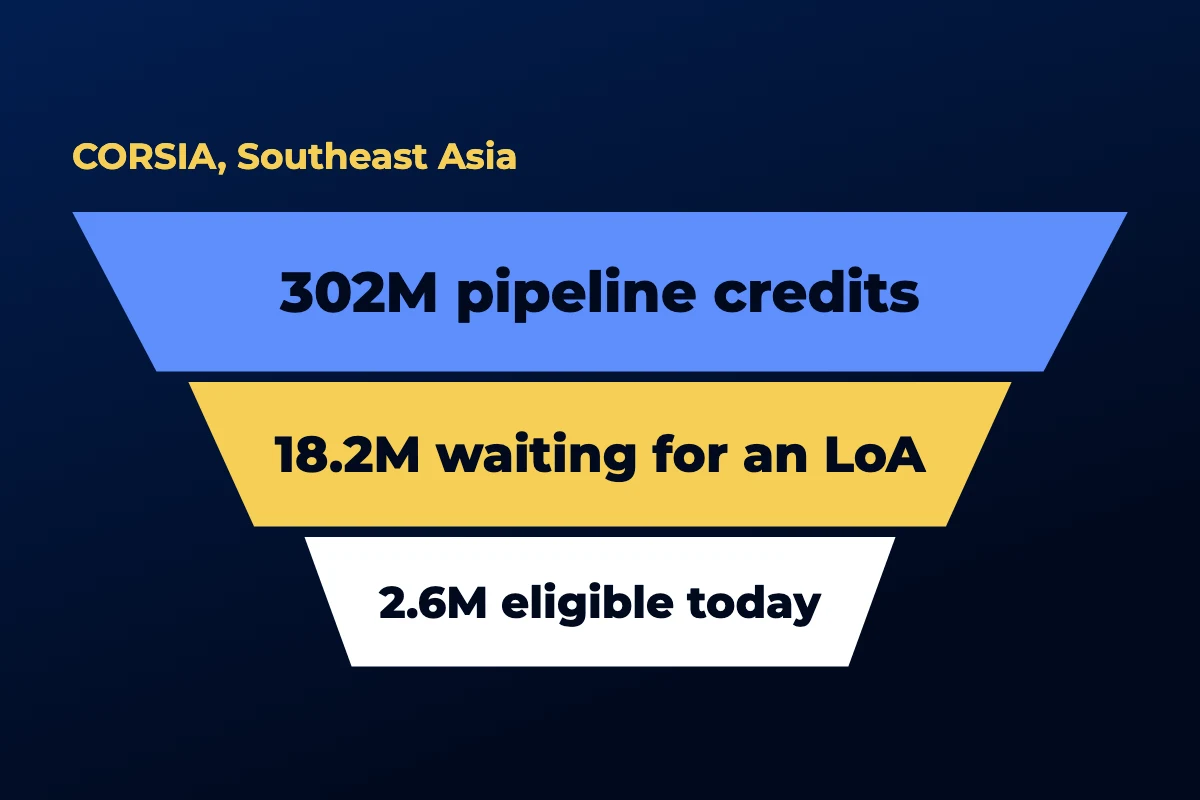
Southeast Asia could close a meaningful part of that gap. The region hosts 54 projects whose credits already meet CORSIA’s technical rules, representing 18.2 million credits that have been issued and are ready to sell. They are missing one thing: authorisation from their host governments.
CORSIA First Phase (2024-2026): demand vs supply
Two tests every CORSIA credit must pass
A carbon credit becomes a CORSIA-Eligible Emissions Unit (CEEU) only when it clears two separate hurdles.
The first is technical. The credit must come from a programme approved by ICAO, such as Verra, Gold Standard or Thailand’s Premium T-VER. It must use an eligible methodology and meet CORSIA’s rules on project start dates and vintages. Most well-run projects can satisfy these conditions.
The second is political. The host country must issue a Letter of Authorisation (LoA) approving the credit for international use, and commit to a corresponding adjustment: removing the reduction from its own national climate accounts so that it is not counted twice. Without that commitment, a credit cannot be used for CORSIA, however strong the project behind it.
It is this second test that is holding back supply.
Southeast Asia’s position
From pipeline to eligible credits
- 302 million creditsPipeline of 100 projects, by 2035
- 18.2 million credits54 projects that meet the rules, awaiting an LoA
- 2.6 million creditsEligible today, 4 projects in Cambodia and Laos
The scale of the opportunity was set out in a July 2026 report by Boeing, GenZero and Abatable, using data as of 1 June 2026.
| Supply category | Volume | Status |
|---|---|---|
| CORSIA-eligible | 2.6 million credits | Already authorised. All from four cookstove and water-purifier projects in Cambodia and Laos, such as VCS 2924 |
| CORSIA-aligned | 18.2 million credits from 54 projects | Meet the rules but lack an LoA. 24 projects are in Vietnam, 11 in Thailand and 8 in Myanmar. |
| Pipeline | Up to 302 million credits by 2035 from 100 projects | Under development; eligibility depends on future authorisations |
ASEAN airlines are expected to need 17-18 million credits for the First Phase. The region’s eligible and aligned supply together, 20.8 million credits, would cover that in full. Across the next decade, the report values the region’s total CORSIA opportunity at up to US$8.5 billion, more than 60% of it in Vietnam.
Why governments hesitate
Authorising credits is not an administrative formality. Every tonne a government authorises for export is a tonne it can no longer count toward its own Nationally Determined Contribution (NDC). Before signing, officials need confidence on three points:
- that the reductions go beyond measures already counted in the national climate plan;
- that authorising them will not leave the country short of its own target, the risk known as “overselling”; and
- that the ministries responsible for climate, energy and aviation agree.
Countries also need the institutions to manage this: a designated authority, a national registry, and reporting under the Paris Agreement’s transparency framework. Readiness varies widely across the region:
- Cambodia, Laos and Thailand have issued LoAs.
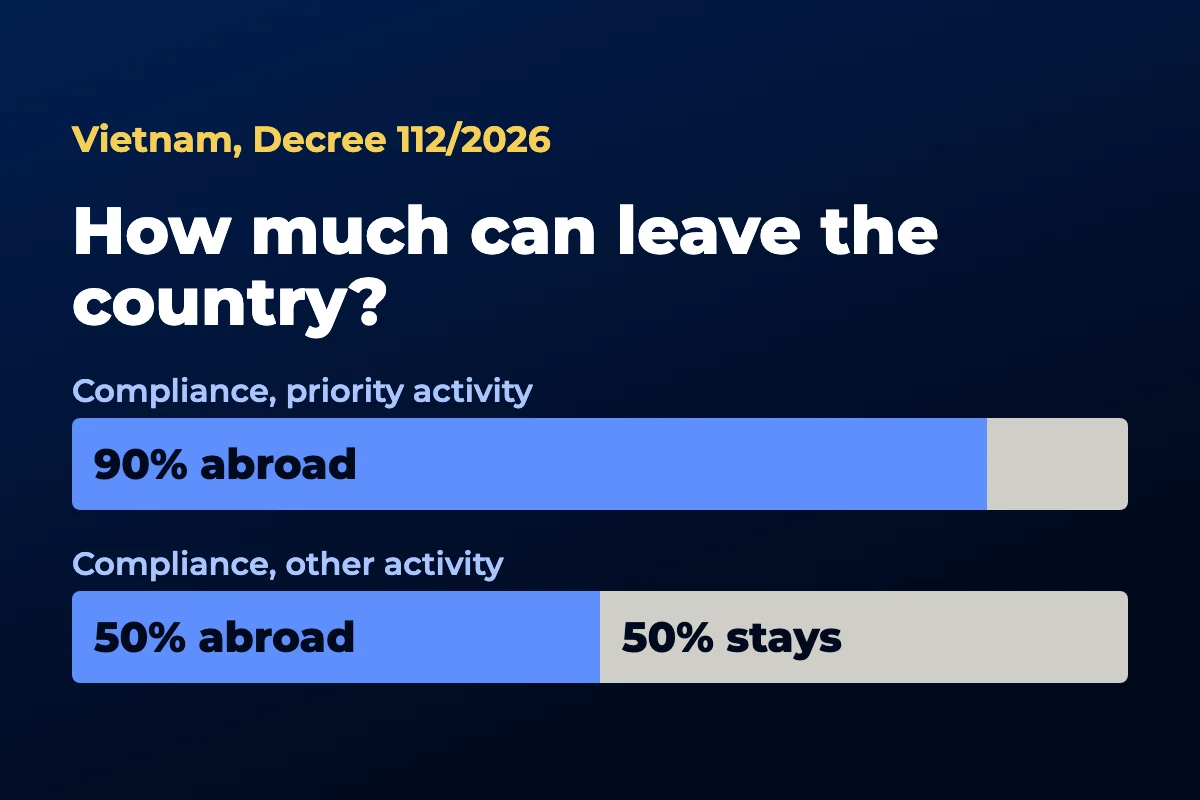
- Vietnam adopted detailed rules in Decree 112/2026 but has yet to issue its first letter.
- Indonesia and the Philippines are still building their frameworks.
There are signs of movement. In late September 2026, new LoAs covering nearly 3 million credits were announced globally, and CORSIA futures continued to recover (Carbon Pulse).
A volatile market with a fixed deadline
CORSIA First Phase spot price, 2026 (US$ per credit)
- 17 Jul: EU exempts Phase 1 credits
- Low: weak demand, jet-fuel costs
Prices have reflected the uncertainty.
| Period | First Phase spot price | Driver |
|---|---|---|
| Late 2025 | Above US$20 | |
| Late June 2026 | US$9.30 | Weak airline demand, higher jet-fuel costs and expanding supply |
| July 2026 | About US$13 | The European Commission exempted First Phase credits from proposed extra quality criteria |
| Mid-September 2026 | Just above US$12 | (Tasman Environmental Markets) |
Short-term prices matter less than the calendar. Airlines must surrender First Phase credits by January 2028, and so far most have bought slowly. If purchasing concentrates in 2027, buyers will compete for whatever authorised supply exists at that point. The countries that authorise early will be best placed to meet that demand.
What this means for buyers and governments
For airlines and intermediaries, waiting for authorised supply to appear carries risk. Practical steps include:
- running pilot purchases now, as Singapore Airlines and Scoot (150,000 credits) and Japan Airlines (250,200) already have;
- contracting forward on CORSIA-aligned projects, with terms conditional on authorisation; and
- spreading purchases across countries and project types.
For governments in the region, the report’s recommendations centre on starting small:
- map which projects fall outside existing NDC measures;
- coordinate across ministries;
- publish a list of priority activities; and
- pilot authorisations on a share of eligible volumes.
Before you buy: 5 questions for your seller
- Is the credit from an ICAO-approved programme and methodology?
- Does the vintage match the CORSIA phase you are complying for?
- Has the host country issued a Letter of Authorisation that covers CORSIA use?
- Has the corresponding adjustment been applied, or is it insured?
- Does the credit carry a CORSIA-eligible label on the registry?
Where Aquila fits
Aquila develops carbon projects in Southeast Asia with authorisation in mind from the outset, across eMobility, waste and industry. We design methodology and IoT-based monitoring so that host governments have verified data they can review with confidence. As authorisation frameworks mature, credits built this way will be among the first ready to qualify for CORSIA.
Sources
- Boeing, GenZero and Abatable (1 July 2026), Unlocking the billion-dollar CORSIA potential in ASEAN: executive summary; “Recommendations for governments”; Annex 5 (data as of 1 June 2026). Press release
- ICAO, CORSIA Eligible Emissions Units
- green.earth, Aviation credit prices jump on CORSIA news (29 Jul 2026)
- Tasman Environmental Markets, Has the CORSIA market turned a corner? (15 Sep 2026)
- Carbon Pulse, VCM report (28 Sep 2026)
- Fastmarkets, CORSIA prices
This article is for general information only and is not legal or investment advice. Figures are as of the dates stated and may change.