Knowledge Hub
The Paris Agreement and Article 6: what they mean for carbon credits in Southeast Asia

How the Paris Agreement reshaped carbon credits, how countries trade emission reductions under Article 6, and what it means for developers, buyers and governments in Southeast Asia.
For most of the past two decades, a carbon credit in Southeast Asia had one main destination: a company somewhere else that wanted to offset its emissions voluntarily. That is changing. Governments, airlines and tax-paying companies are now buying credits to meet legal obligations, and the rules that make this possible come from a single treaty: the Paris Agreement, and in particular its Article 6.
This article explains what the Paris Agreement is, how Article 6 lets countries trade emission reductions, and why that matters for anyone who develops, finances or buys carbon credits in the region.
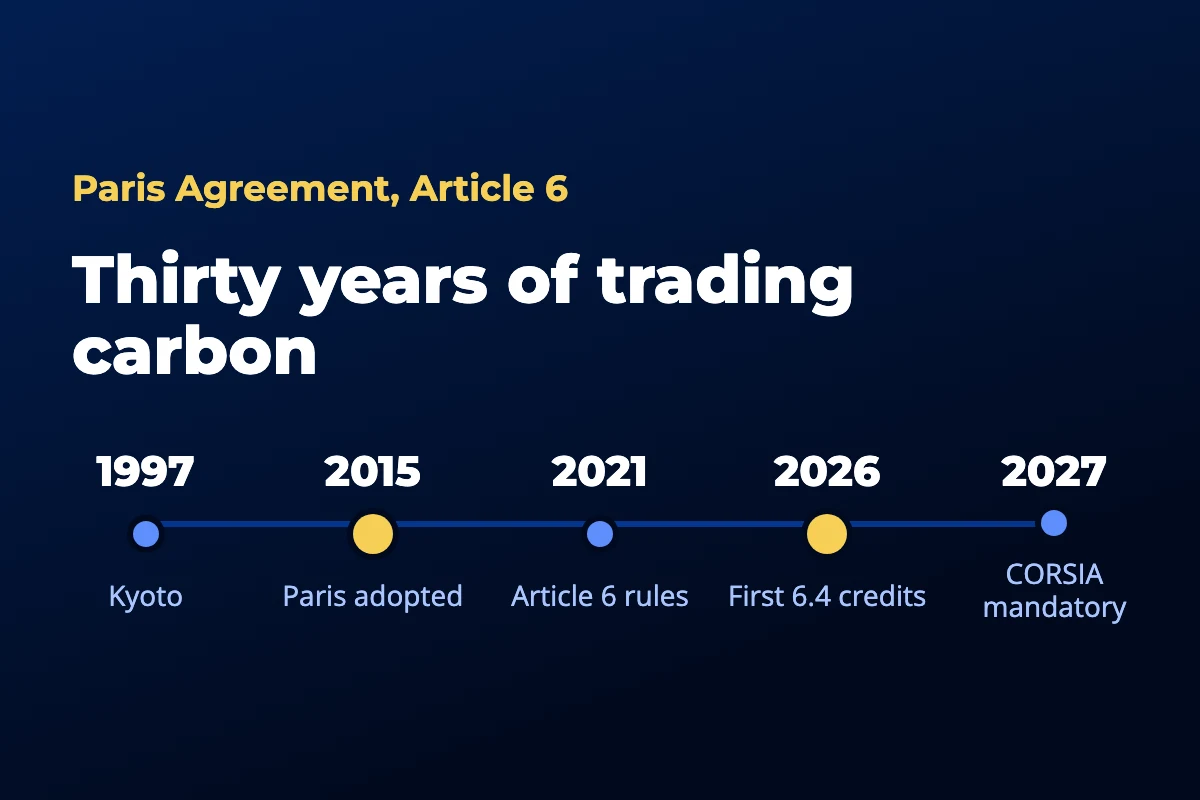
Thirty years of international carbon markets
- 1997Kyoto Protocol; CDM projects begin
- 2015Paris Agreement adopted (COP21)
- 2016Enters into force; ICAO adopts CORSIA
- 2021Article 6 rules agreed (COP26)
- Dec 2023First ITMO transfer: Thailand to Switzerland
- 2024CORSIA First Phase; final Article 6 details (COP29)
- Feb 2026First Article 6.4 credits
- 2026National rules in Southeast Asia, e.g. Decree 112
- 2027CORSIA becomes mandatory
- Jan 2028First Phase surrender deadline
From Kyoto to Paris: a change in who takes responsibility
The world’s first binding climate treaty, the Kyoto Protocol (1997), placed emission targets only on developed countries. Developing countries such as Vietnam, Thailand and Indonesia had no targets of their own. Instead, they could host projects under Kyoto’s Clean Development Mechanism (CDM) and sell the resulting credits to countries that did have targets. This is how many of Southeast Asia’s first carbon projects, from hydropower to landfill gas, were financed.
The Paris Agreement, adopted by 196 parties at COP21 in December 2015, changed that model. Its goal is to hold global warming well below 2°C above pre-industrial levels, and to pursue efforts to limit it to 1.5°C. To get there, it asks every country, rich or poor, to set its own climate target. These targets are called Nationally Determined Contributions (NDCs), and countries must update them every five years with greater ambition each time.
Once every country has a target, every tonne of emissions reduced in that country counts toward something. A tonne cut in Vietnam is no longer just a tonne a buyer can claim. It is also part of Vietnam’s own progress toward its NDC. That simple fact is why the rules for trading carbon credits had to be rewritten.
Conditional and unconditional targets
Many developing countries, including most of Southeast Asia, divide their NDCs into two parts. The unconditional part is what the country commits to achieve with its own resources. The conditional part is a higher level of ambition that it will reach only with international finance, technology or support.
This split matters for carbon markets. Reductions that help a country meet its unconditional target are ones it generally wants to keep and count for itself. Reductions that go beyond it, often financed by foreign buyers, are the ones a country may be more willing to share. Much of the debate about which credits a government will allow to leave the country comes back to this distinction.
Article 6: the rules for cooperation between countries
Article 6 of the Paris Agreement allows countries to cooperate in meeting their targets, including by transferring emission reductions from one country to another. It took six years of negotiations, until COP26 in Glasgow in 2021, to agree how this should work, and the final technical details were settled at COP29 in Baku in 2024. Article 6 contains three distinct approaches.
Article 6.2 allows two or more countries to agree directly on how reductions will be transferred between them. The units they trade are called Internationally Transferred Mitigation Outcomes (ITMOs). Each deal is set out in a bilateral agreement, so the buyer and host country decide the eligible project types, methodologies and procedures between them. Switzerland, Singapore, Japan and Korea are the most active buyers using this route. In December 2023, Thailand and Switzerland completed the world’s first transfer of ITMOs for NDC use under Article 6.2: 1,916 tonnes from the Bangkok E-Bus Programme.
Article 6.4 creates a centralised, UN-supervised crediting mechanism, the Paris Agreement Crediting Mechanism (PACM), which effectively succeeds the Kyoto-era CDM. Projects are registered and credits issued under rules and methodologies set by a UN Supervisory Body. The first PACM credits were issued in February 2026, for a clean-cooking project in Myanmar. Early evidence suggests PACM will be more conservative than the CDM: those first credits came in roughly 40% below what the CDM would have issued for the same activity.
Article 6.8 covers non-market cooperation, such as technology transfer, capacity building and finance, where no credits change hands.
The three approaches under Article 6
- 6.2Bilateral cooperationCountries agree directly how reductions move between them. Units are called ITMOs.Example: Thailand to Switzerland
- 6.4UN crediting mechanismThe Paris Agreement Crediting Mechanism (PACM), successor to the CDM. Units are called A6.4ERs.First credits: Feb 2026
- 6.8Non-market cooperationTechnology transfer, capacity building and finance.No credits change hands
The key to it all: corresponding adjustments
If every country has a target, a transferred reduction risks being counted twice: once by the host country toward its NDC, and again by the buyer. Article 6 prevents this through a corresponding adjustment.
Consider a simple example. A project in Vietnam reduces emissions by 1,000 tonnes, and those reductions are sold to Singapore. Singapore adds 1,000 tonnes to its side of the ledger and counts them toward its target. Vietnam must then remove the same 1,000 tonnes from its own accounts, as though the reduction had never happened on Vietnamese soil. The reduction is counted once, by the country that paid for it.
Before this can happen, the host government issues a Letter of Authorisation (LoA): a formal commitment that it authorises the reductions for international use and will apply the corresponding adjustment in its reports to the UN.
For a host government, this is a real trade-off. Every tonne it authorises for export is a tonne it gives up toward its own NDC. Authorising too much could leave the country short of its own target. This is why governments across Southeast Asia have moved carefully, and why the LoA has become the single most important document in the compliance carbon market.
The reduction is counted once, by the country that paid for it
| Project reductions | 1,000 t |
|---|---|
| Transferred abroad | -1,000 t |
| Counts toward own NDC | 0 t |
| Units received | +1,000 t |
|---|---|
| Counts toward own NDC | 1,000 t |
| Double counting | None |
Three markets, one credit
Article 6 has effectively split the carbon credit market into three overlapping uses. In each case the same project can generate credits, but the paperwork behind them differs.
The first is compliance use under Article 6, where credits count toward another country’s NDC, or toward a national scheme that accepts international credits. Singapore’s carbon tax is an example: companies may offset up to 5% of their taxable emissions with eligible international credits, provided those credits are authorised and correspondingly adjusted. Here, an LoA is essential.
The second is CORSIA, the UN’s carbon offsetting scheme for international aviation. Airlines must offset the growth in their international emissions using credits that meet ICAO’s criteria and carry host-country authorisation under Article 6. CORSIA’s First Phase runs from 2024 to 2026, and from 2027 participation becomes mandatory for most countries.
The third is the voluntary market, where companies buy credits to support their own climate claims. These credits usually do not need an LoA or a corresponding adjustment, although a growing number of buyers now ask for one to strengthen their claims.
The first two are where demand is growing fastest, and both depend on the same thing: a host country willing to authorise its credits.
Three uses, one credit, different paperwork
- Article 6 complianceCredits count toward another country's NDC, or schemes such as Singapore's carbon tax.LoA required
- CORSIAAirlines offset growth in international aviation emissions.LoA required
- Voluntary marketCompanies buy credits for their own climate claims.LoA usually not required
What this means for Southeast Asia
Article 6 readiness, mid-2026
- ThailandLoAs issuedITMOs transferred
- Cambodia, LaosLoAs issuedSupplying CORSIA
- VietnamFramework readyDecree 112/2026; no LoA yet
- IndonesiaIn progressSector by sector
- PhilippinesIn progressFramework in draft
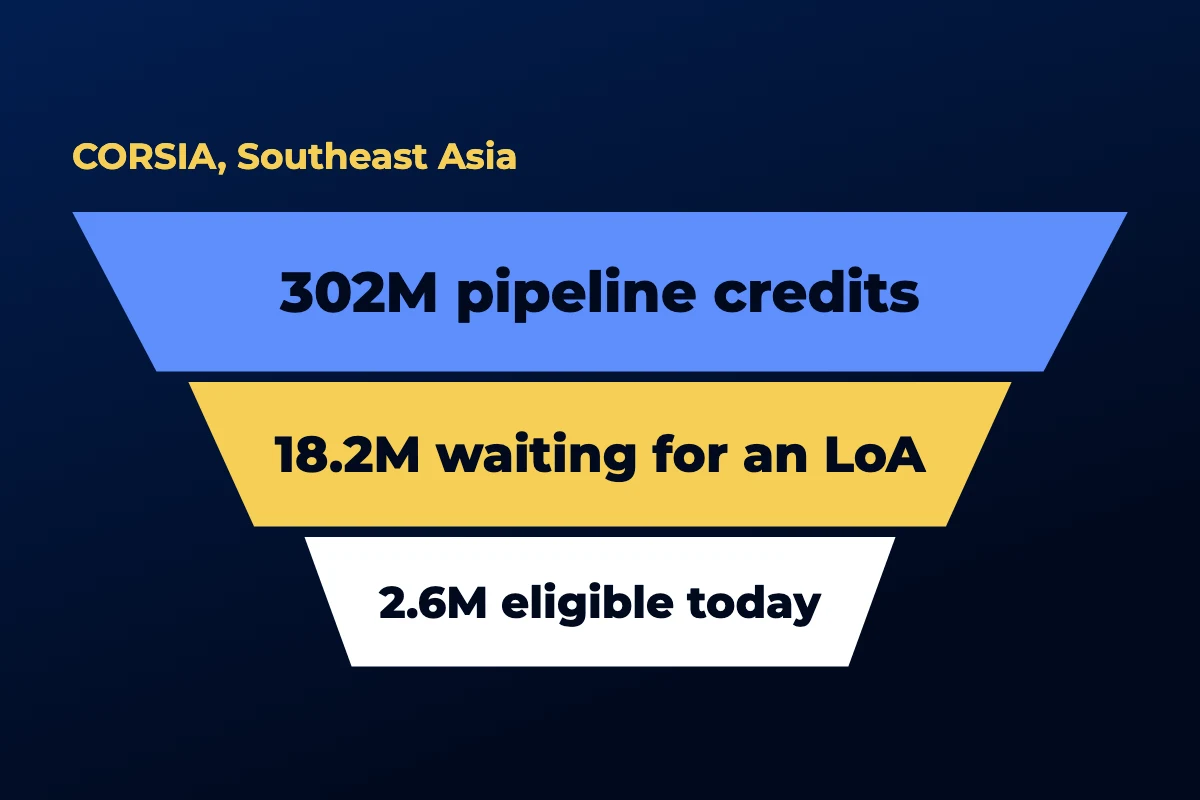
Southeast Asia sits in an unusual position. On one side, it has one of the world’s richest pipelines of carbon projects: renewable energy, clean cooking, electric mobility, waste management, industrial efficiency and forestry. On the other, it borders some of the most active Article 6 buyers. Singapore, Japan and Korea are all signing agreements with countries in the region.
What connects the two is government readiness. The countries in the region are at very different stages:
- Thailand has an operational authorisation process, has issued LoAs and has already transferred ITMOs.
- Cambodia and Laos have issued LoAs, and their projects already supply credits to airlines under CORSIA.
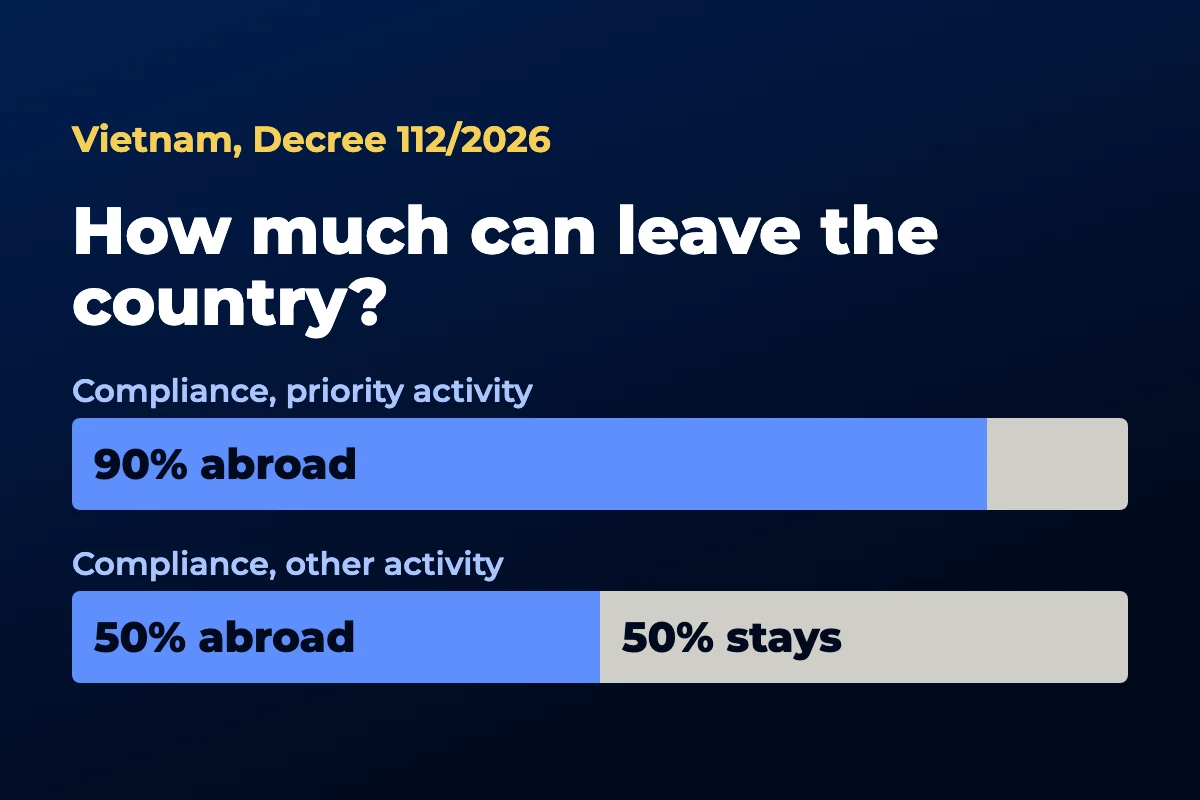
- Vietnam set out detailed rules for international transfers in Decree 112/2026, including caps on how much of a project’s credits may be exported, but had not yet issued its first LoA as of mid-2026.
- Indonesia and the Philippines are building their frameworks sector by sector.
For project developers, this means a credit’s value increasingly depends not only on the project itself but on whether, and how much of it, the host country will authorise. Planning for authorisation needs to start at project design, not after issuance.
For buyers, it means asking new questions before signing: Is there an LoA? Does it cover the intended use? Has the corresponding adjustment been applied?
For governments, it means balancing the investment and revenue that authorised credits bring against the need to protect their own climate targets.
Timeline: how we got here
| Year | Milestone |
|---|---|
| 1997 | Kyoto Protocol adopted; the CDM lets developing countries host credit-generating projects |
| 2015 | Paris Agreement adopted at COP21 |
| 2016 | Paris Agreement enters into force; ICAO adopts CORSIA |
| 2018 | COP24 in Katowice agrees most of the Paris “rulebook”, but not Article 6 |
| 2021 | COP26 in Glasgow agrees the core Article 6 rules |
| 2021-2023 | CORSIA pilot phase |
| Dec 2023 | First ITMO transfer under Article 6.2 (Thailand to Switzerland, Bangkok E-Bus Programme) |
| 2024 | CORSIA First Phase begins; COP29 in Baku finalises the remaining Article 6 details |
| 2025 | Countries submit new NDCs with 2035 targets; COP30 in Belém |
| Feb 2026 | First credits issued under Article 6.4 (Myanmar) |
| 2026 | Southeast Asian countries roll out national Article 6 rules, such as Vietnam’s Decree 112/2026 |
| 2027 | CORSIA Second Phase begins and becomes mandatory for most countries |
| Jan 2028 | Deadline for airlines to surrender First Phase credits |
Sources
- UNFCCC, The Paris Agreement
- UNFCCC, first issuance under the Paris Agreement Crediting Mechanism (Feb 2026)
- ICAO, CORSIA
- Singapore NCCS, Carbon tax
- Abatable (2026), Unlocking the billion-dollar CORSIA potential in ASEAN (glossary; Annex 5; Tables A27 and A32)
- Decree 112/2026/ND-CP (English translation), LuatVietnam
This article is for general information only and is not legal or investment advice. Figures are as of the dates stated and may change.