
As the world intensifies its efforts to combat climate change, the carbon credits market has become a key mechanism in facilitating the transition to a low-carbon economy. Central to this market are investors and buyers, whose demand for carbon credits drives growth and innovation in climate action projects. These actors play a pivotal role in shaping the market, setting price benchmarks, and ensuring that emission reduction projects are funded and scaled. In this article, we will explore how investors and buyers are transforming the carbon credits market and driving the momentum for global sustainability.

Carbon credit investors are a diverse group, including major corporations (like Microsoft, Google) seeking to meet climate goals, specialized investment funds (like Rubicon Carbon), financial firms, speculators trading for profit, and even individuals buying offsets, all investing in projects that reduce or remove emissions (reforestation, renewable energy, tech) to generate financial returns or fulfill ESG mandates. They provide essential capital for climate solutions, funding everything from nature-based projects to direct air capture technologies.
Investors are at the heart of the carbon credits market. Their capital supports the development and scaling of carbon offset projects, which reduce or remove greenhouse gases from the atmosphere. Through impact investing and sustainable finance, investors help channel significant financial resources into climate solutions such as renewable energy, forest conservation, and carbon capture technologies.
According to the International Finance Corporation (IFC), climate-linked revenues, including those from carbon credits, provide predictable cash flow for projects, improving their financial visibility and making them more attractive to investors. These revenue streams help mitigate risks, offering investors a secure return on their capital while simultaneously contributing to climate action. Furthermore, the financial returns from carbon credits can be substantial, with the growth of voluntary carbon markets drawing increasing interest from institutional investors seeking to diversify their portfolios with sustainable assets.
Through carbon markets, investors are not only generating returns but are also accelerating the global transition to net-zero emissions. By purchasing carbon credits, investors signal market confidence in projects that drive tangible environmental benefits. This creates a virtuous cycle, where demand for carbon credits grows as more investors back emission-reduction initiatives, leading to more investment opportunities.
Buyers, ranging from large corporations to governments and even individual buyers, create demand for carbon credits. These actors purchase credits to offset their emissions, align with sustainability goals, and meet regulatory requirements. As companies face increasing pressure from consumers, investors, and regulators, buying carbon credits allows them to demonstrate their commitment to achieving net-zero emissions.
Large corporate buyers, in particular, have a significant impact on the carbon credit market. According to the Green Finance Institute, these buyers often set sustainability criteria for the projects they invest in, driving high-quality standards in the market. As corporations strive to meet ambitious emissions reduction targets, they seek out verifiable, high-quality credits that align with their climate commitments. This increases the demand for credits from projects that are certified under recognized standards such as Verra and Gold Standard, ensuring the credits they purchase deliver real, measurable environmental benefits.
Moreover, some buyers’ clubs and corporate partnerships are now emerging, where multiple entities collaborate to purchase carbon credits in bulk.
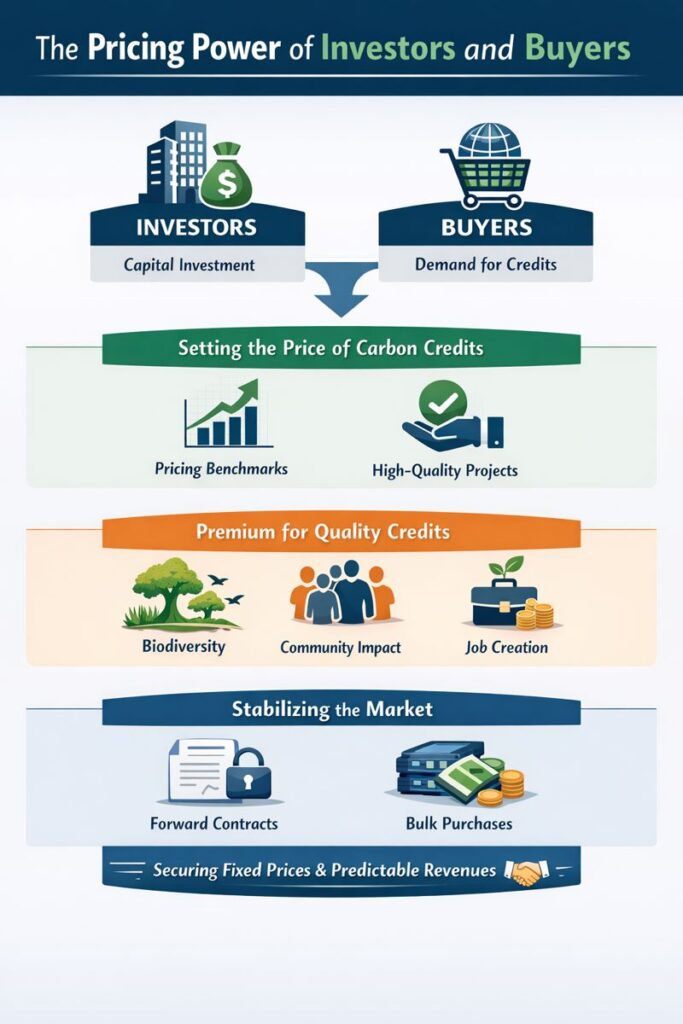
This collective buying power helps stabilize prices and provides long-term financial security for smaller carbon offset projects that might otherwise struggle to attract financing. By buying carbon credits in bulk, large buyers help ensure a steady demand for carbon credits, thereby making these projects more bankable and more likely to receive ongoing investment.
Both investors and buyers play an essential role in setting the price of carbon credits. Investors, through their capital injections, influence the financial viability of carbon credit projects, helping to establish pricing benchmarks. On the buyer’s side, demand for credits, especially those tied to high-quality projects, directly impacts market pricing.
As noted by the Boston Consulting Group (BCG), buyers are willing to pay a premium for high-quality, verified credits that come from projects with strong sustainability credentials. This premium pricing helps foster a quality-driven market, where buyers are incentivized to purchase credits that offer additional environmental benefits beyond just carbon offsetting, such as biodiversity conservation, community development, and job creation.
The price volatility in carbon credit markets also presents an opportunity for investors and buyers to leverage their purchasing power. By locking in forward contracts or engaging in bulk purchasing agreements, they can secure credits at a fixed price, helping to mitigate risk and stabilize their exposure to price fluctuations in the carbon market. This not only benefits buyers and investors but also provides predictable revenues for project developers.
As demand for carbon credits grows, maintaining market integrity is critical. Buyers and investors, as market leaders, are directly responsible for ensuring that the projects they fund or purchase credits from, meet the highest environmental and social standards. By prioritizing verified credits, buyers ensure that carbon offset projects actually deliver real emissions reductions and are aligned with global climate goals.
Furthermore, many investors and buyers are demanding greater transparency in the carbon credit market. They are pushing for more robust monitoring, reporting, and verification (MRV) systems to ensure that the credits they purchase are credible and verifiable. Initiatives such as the Carbon Credit Confidence Initiative from the organization Agreena and the Global Carbon Standard are setting frameworks to ensure buyers and investors have access to clear, verified data about the carbon credits they invest in.
This push for greater transparency is not only driven by ethical concerns but also by market dynamics. As carbon credit prices rise, ensuring transparency and accountability becomes critical to maintaining the credibility of the market and the long-term value of carbon credits as a financial asset.
Investors and buyers are the driving forces behind the carbon credits market, playing a pivotal role in determining market prices, ensuring project quality, and mobilizing financial resources for climate action. Their influence is shaping the future of carbon markets, making them not only a key climate tool but also a significant financial opportunity. As demand for carbon credits grows, high-quality projects will continue to attract investment, creating a virtuous cycle of growth, sustainability, and climate action.
To learn more about how your company can leverage the carbon credits market to meet climate goals and investment opportunities, contact us today.