
In the face of escalating climate change, businesses and governments around the world are seeking effective ways to mitigate their environmental impact. Among the most promising strategies are carbon credits and the circular economy. While these two concepts have gained considerable attention on their own, understanding how they intersect can reveal new pathways to achieving sustainability.
Carbon credits are an economic tool designed to incentivize the reduction of greenhouse gases (GHGs). On the other hand, the circular economy focuses on minimizing waste and making the most of available resources through practices such as recycling, reusing, and refurbishing. Together, these two mechanisms form a powerful combination that can help businesses reduce emissions, promote environmental stewardship, and drive financial value. But how exactly do they work together?
Let’s explore how the principles of the circular economy support the generation of carbon credits and how businesses can integrate these two concepts into their sustainability strategies.

Carbon credits are certificates issued to companies or organizations that have reduced their carbon emissions or engaged in activities that absorb carbon from the atmosphere. For example, a company that invests in reforestation projects or installs renewable energy systems can earn carbon credits for the emissions they save or offset.
Each carbon credit typically represents one metric ton of CO₂ emissions that has been avoided or removed from the atmosphere. These credits can then be sold or traded on carbon markets, allowing businesses to offset their own emissions by purchasing credits from those that are able to reduce or remove more.
The circular economy is an alternative to the traditional linear economy, where products are made, used, and discarded. Instead, the circular model focuses on reducing waste, reusing products, and recycling materials to extend their lifecycle. This approach reduces the need for raw materials and energy, which ultimately leads to a significant reduction in emissions.
In essence, the circular economy aims to close the loop by creating a system where waste is minimized, and resources are continually reused. This model can play a crucial role in mitigating climate change by reducing the demand for new raw materials and minimizing the environmental footprint of industrial activities.
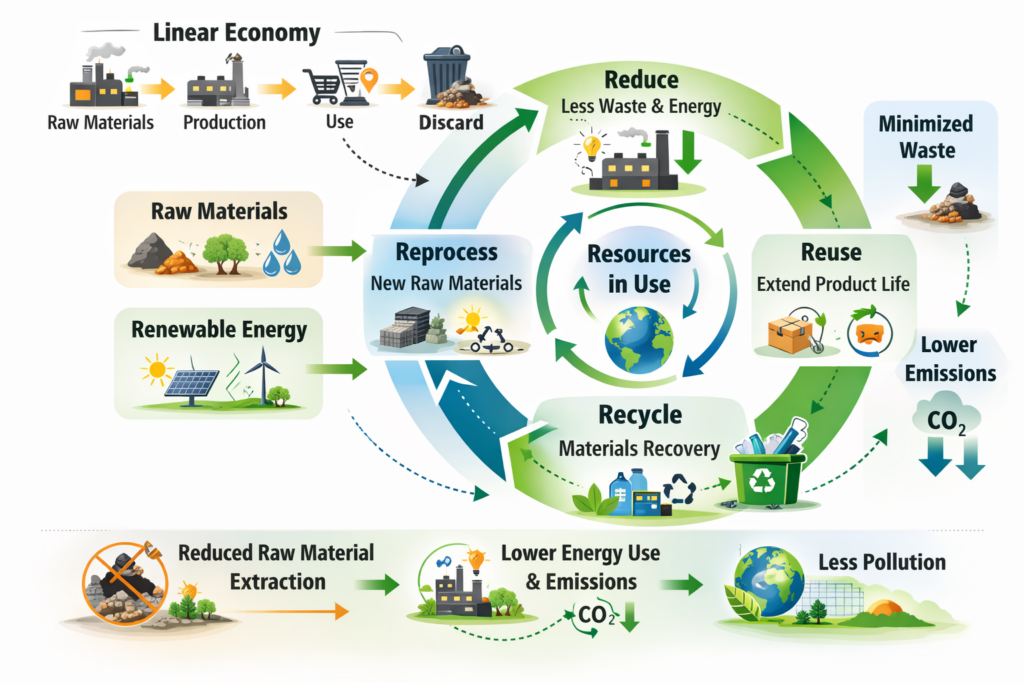
One of the key ways in which circular economy practices contribute to carbon credit generation is by reducing emissions through improved resource efficiency. For example, when companies reuse materials or recycle waste, they are reducing the need for energy-intensive processes such as mining and manufacturing. These activities typically generate significant emissions, so cutting them down directly impacts a company’s carbon footprint.
By adopting circular economy principles, businesses can create measurable reductions in emissions, which can then be used to generate carbon credits. A prime example is the recycling of plastics or metals, which can reduce the need for new raw materials, saving energy and reducing emissions. These emissions savings can be certified as carbon credits, which companies can sell on the market.
Certain circular economy projects, like bioenergy generation from waste or capturing methane from landfills, have the potential to generate substantial amounts of carbon credits. When organic waste decomposes in landfills, it releases methane, a potent GHG. By capturing and using this methane as a renewable energy source, companies can prevent its release into the atmosphere, thereby generating carbon credits.
For instance, a company that collects methane from landfill waste and uses it to produce electricity can earn carbon credits for reducing methane emissions, which are much more harmful than CO₂. Similarly, converting waste into usable energy reduces the need for fossil fuels, further decreasing emissions and creating opportunities for carbon credit generation.
LanzaTech uses a proprietary gas fermentation technology to capture methane and carbon monoxide from industrial waste gases, such as those emitted by landfills and steel mills. They convert these gases into ethanol and other chemicals, which can be used as renewable fuel or industrial feedstock. By preventing the release of methane into the atmosphere, LanzaTech not only reduces emissions but also earns carbon credits for the avoided emissions, which are then sold to companies needing to offset their own carbon footprints.
The intersection of carbon credits and the circular economy can unlock new financial opportunities for businesses. As companies reduce their carbon emissions through circular practices, they can generate carbon credits, which provide an additional revenue stream. This creates an economic incentive for businesses to implement circular economy strategies, as they can sell their carbon credits to other businesses that need to offset their emissions.
By integrating carbon credits into their circular economy models, companies can not only support environmental sustainability but also improve their bottom line. For example, businesses that adopt closed-loop supply chains—where materials are recycled back into the production process—can significantly reduce their emissions and earn carbon credits. These credits can then be sold to other companies looking to meet their carbon offset requirements.
A relevant case illustrating this is Interface Inc., a global leader in sustainable flooring solutions. Interface has adopted a closed-loop supply chain by reclaiming and recycling its carpet tiles. The company collects used tiles, removes the old fibers, and regenerates them into new tiles for production. By reducing its reliance on virgin materials and reprocessing waste into usable products, Interface significantly reduces its carbon footprint. This closed-loop process helps the company earn carbon credits for the emissions saved by reducing waste and using recycled materials. These credits are then sold to other businesses aiming to meet their own carbon offset goals, contributing to both environmental sustainability and financial profitability.
In addition to financial incentives, businesses that adopt circular economy practices and engage in carbon credit programs can strengthen their market position. By demonstrating a commitment to sustainability, companies can enhance their brand value and attract eco-conscious investors. The combination of both circularity and carbon credit generation offers a compelling proposition for companies looking to lead in the sustainability space.

Various global frameworks and policies are beginning to recognize the synergy between carbon credits and the circular economy. For example, the EU Green Deal encourages businesses to adopt both circular practices and carbon credit systems as part of their sustainability strategies. The G20 Circular Carbon Economy Initiative also advocates for the integration of carbon markets and circular economy principles as a way to drive meaningful environmental change.
In addition to international agreements, governments worldwide are offering incentives for companies that invest in circular economy and carbon credit initiatives. Tax breaks, grants, and subsidies are often available for businesses that engage in activities such as recycling, waste reduction, or renewable energy projects. These incentives not only help businesses offset the costs of adopting sustainable practices but also provide a clear financial benefit for participating in carbon credit markets. If that is of interest to your business, feel free to contact us!
By combining circular economy strategies with carbon credits, businesses can achieve significant cost savings and revenue generation. Implementing circular practices such as waste reduction or recycling can lower production costs, while carbon credits provide a financial reward for reducing emissions. Together, these approaches can help businesses improve their profitability while also contributing to global climate goals.
Adopting circular economy practices and generating carbon credits can also enhance a business’s reputation in the market. Companies that are committed to sustainability are increasingly seen as leaders in their industries, attracting more customers, partners, and investors. By integrating both concepts, businesses can position themselves at the forefront of the sustainability movement, ultimately driving long-term growth and success.
A concrete example of this is Patagonia, the outdoor clothing company renowned for its strong commitment to sustainability. Patagonia has adopted circular economy practices by promoting product repairs, recycling, and using sustainable materials, such as recycled polyester. The company also generates carbon credits through its investment in renewable energy projects and efforts to reduce emissions from its supply chain. These actions have not only helped Patagonia reduce its environmental impact but also boosted its brand image, making it a leader in sustainable business practices. As a result, Patagonia has attracted a loyal customer base, strong partnerships with environmentally-conscious companies, and investment opportunities from eco-focused funds. Their commitment to sustainability has cemented their position at the forefront of the green business movement.

In conclusion, the combination of carbon credits and the circular economy offers a powerful solution for businesses looking to reduce their carbon footprint, improve sustainability, and create new revenue streams. By adopting circular practices, companies can not only minimize waste and optimize resource use but also generate valuable carbon credits that support climate action efforts. As global policies and frameworks continue to evolve, businesses that integrate these two strategies will be well-positioned to thrive in a sustainable future.